
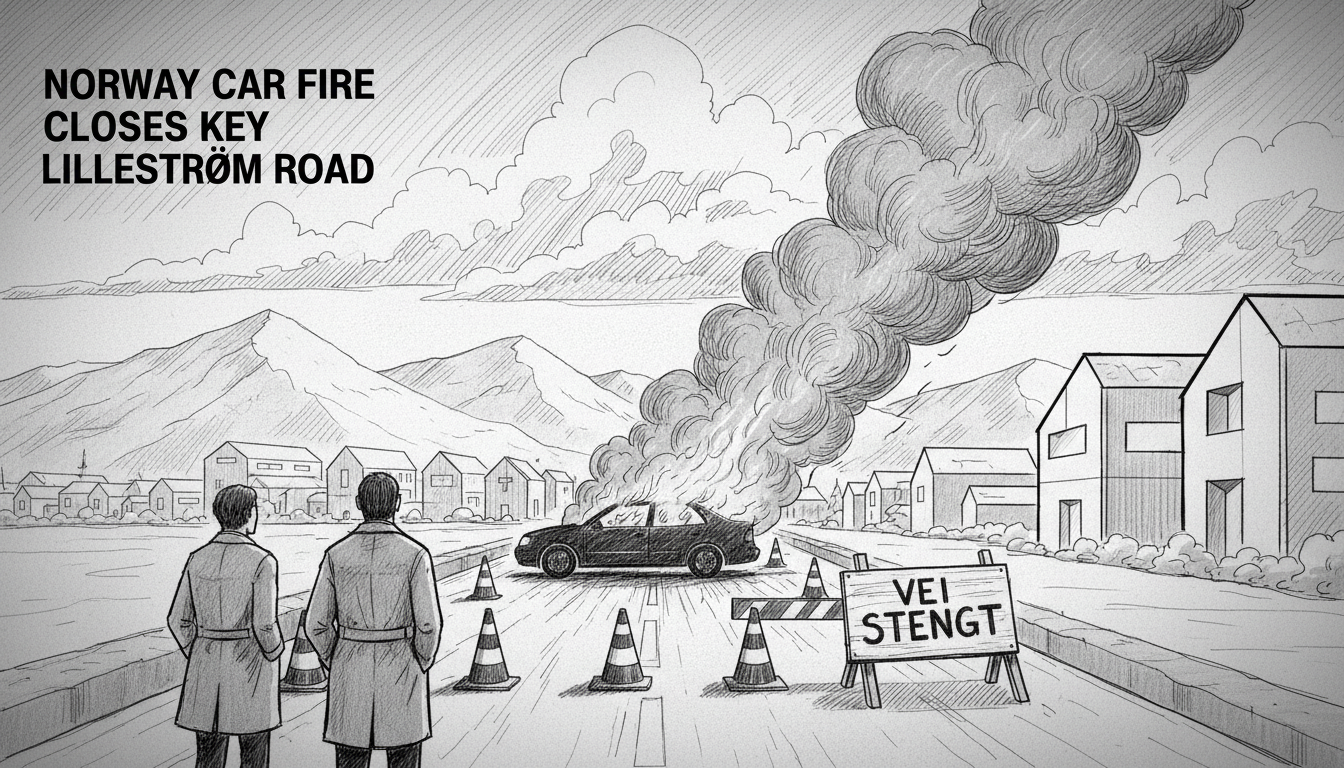
Norway car fire on the busy Fetveien road in Lillestrøm caused significant traffic disruption and sent two people to hospital on Thursday afternoon. Police received the initial report at 15:40 local time, responding to a vehicle with flames erupting from its engine compartment. The incident forced the immediate closure of a major arterial route in this critical Oslo-region transport hub, with emergency crews working to reopen the road by 16:04. Two occupants of the car were transported to the Legevakt emergency clinic for assessment, likely due to smoke inhalation, according to police operations leader Ronny Hellerud Samuelsen. The vehicle was completely destroyed by the blaze.
A Rush Hour Incident in a Transport Nexus
Lillestrøm's role as a central node in the greater Oslo area's transport network amplified the impact of this sudden road closure. The town is not just a municipality center for Viken county; it is a crucial convergence point for rail and road traffic moving east from the capital. Fetveien serves as a key local connector, feeding into larger European routes like the E6 and E16. A closure during the mid-afternoon, as the early stages of evening rush hour begin, creates a cascade of congestion. Commuters heading out of Oslo towards municipalities like Rælingen, Fet, and Aurskog-Høland found their routes abruptly altered. Police protocols in such incidents prioritize securing the scene, ensuring no risk of explosion from fuel tanks or vehicle systems, and providing immediate medical aid. Only after these safety checks can traffic flow resume.
The Human and Systemic Response
The swift medical response for the two individuals highlights standard Norwegian emergency procedure. Smoke inhalation is a serious and sometimes delayed threat, causing damage to the respiratory tract. Transport to the Legevakt for examination is a precautionary measure to assess for carbon monoxide poisoning or lung irritation. Meanwhile, the operational response follows a clear chain. The police operations leader, coordinating from a central communications hub, logs all details in a press log available to media. This system provides real-time, factual updates to the public. Fire crews from the Lillestrøm fire station would have focused on extinguishing the engine fire—a task complicated by modern vehicle materials and electrical systems. Their secondary duty is to make the scene safe for recovery and reopening, which they accomplished within approximately 25 minutes of the initial call, a testament to efficient local services.
Analyzing the Ripple Effects of a Single Event
While the event itself was contained quickly, it offers a case study in urban vulnerability. A single vehicle fire on the right stretch of road can paralyze a significant portion of local infrastructure. Traffic management systems in Norway are advanced, with variable message signs and coordinated GPS rerouting through apps like Google Maps and Yr. However, physical alternatives are limited by geography. Lillestrøm is situated between the Glomma river and railway lines, creating natural bottlenecks. Incidents like this test the resilience of daily logistics, from public transport buses to commercial deliveries. They also silently underscore the economic cost of unexpected disruptions. The value of lost time for hundreds of delayed motorists, coupled with increased fuel consumption from idling and detours, adds up quickly, even from a short closure.
Vehicle Safety and Fire Risks in Focus
This incident inevitably turns attention to vehicle fire causes. Engine compartment fires can originate from electrical faults, fluid leaks onto hot components, or turbocharger issues. Modern cars, with dense packaging of components and high-pressure fuel systems, present unique challenges for firefighters. The Norwegian Directorate for Civil Protection (DSB) and the Fire Protection Association work on guidelines for responding to such incidents, especially with the rise of electric vehicles, though this particular case involved a traditional combustion engine. For motorists, the key takeaways are immediate: at the first sign of smoke or unusual smell, safely stop the vehicle, shut off the ignition, evacuate all passengers at a safe distance, and call emergency services at 110 for the fire department or 112 for police. Attempting to extinguish an engine fire without proper equipment is extremely dangerous.
The Broader Context of Norwegian Road Safety
Norway maintains one of the world's lowest rates of traffic fatalities, a achievement built on rigorous vehicle inspections (EU kontroll), strict traffic laws, and excellent emergency response. A non-collision fire is a relatively rare event within this safety ecosystem. The country's mandatory vehicle insurance (ansvarsforsikring) would cover liability, while comprehensive insurance (kaskoforsikring) typically covers fire damage to the vehicle itself. The rapid reopening of Fetveien reflects a priority on restoring normalcy and minimizing secondary risk. Lingering debris or fluid on the road could cause subsequent accidents, so a thorough cleanup is part of the operation. This efficient resolution from crisis to cleared roadway is a routine expectation in Norway, yet it relies on well-funded, trained municipal and state services.
A Return to Normalcy and Lingering Questions
By 16:04, the road was being reopened. Traffic began to flow again, the detour signs were removed, and the rhythm of a Thursday afternoon resumed. The burnt-out vehicle was towed to a secure yard for potential inspection, though most causes in such cases are deemed accidental. The two individuals received care and were likely released with advice to monitor their symptoms. For the residents of Lillestrøm and the thousands who pass through it, the event became a brief inconvenience, a topic for dinner table conversation, or a notification on a traffic app. Yet it stands as a reminder of how fragile our daily mobility can be. It highlights the silent, efficient work of emergency responders who manage these disruptions. It also poses an unspoken question: in our increasingly dense urban regions, how do we build transport networks that are not just efficient, but resilient to the inevitable, unexpected spark?