
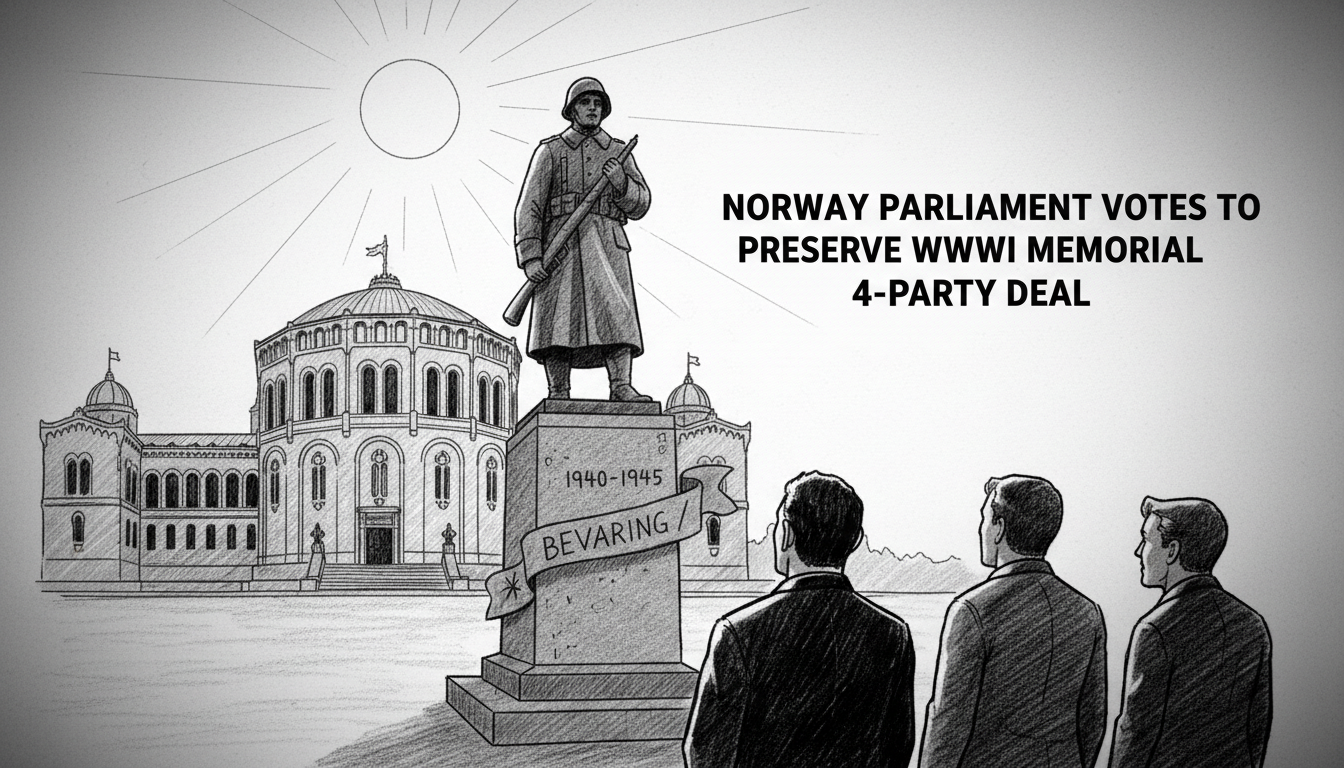
Norway's parliament has secured a majority to preserve the controversial 'Rose Castle' art installation at Frognerseteren in Oslo. The Conservative Party (Høyre), the Progress Party (Frp), the Christian Democratic Party (KrF), and the Centre Party (Sp) formed a cross-bloc agreement to keep the World War II memorial at its current location. The decision ends a period of uncertainty for the project, which faced potential relocation or closure.
"The Rose Castle has established itself as a monument and a communicator of these values to today's youth," said Conservative Party politician Tage Pettersen in a statement. He emphasized the site's intrinsic importance. "Much of this is tied to the place. Therefore, we support the foundation's wish for continued operation where they have put down their roots."
The vote represents a significant political endorsement for the memorial's educational mission. It underscores a broad consensus on the importance of preserving tangible connections to Norway's wartime history, even when artistic interpretations spark debate.
A Memorial Rooted in Oslo's Landscape
Roseslottet, or The Rose Castle, is not a traditional museum. It is an immersive art installation that opened to the public on June 12, 2020. That date marked the 80th anniversary of the start of Germany's occupation of Norway. The site, nestled in the wooded hills near the popular Frognerseteren restaurant and ski area, uses paintings, sculptures, and textual narratives to tell the story of the occupation from 1940 to 1945.
Its location is deliberately chosen. Frognerseteren and the surrounding Nordmarka forest were areas of significance during the war, used for recreation by German forces but also as a backdrop for Norwegian resistance and everyday life under oppression. The installation's founders argued that the physical context—the forest, the view over Oslo—is an integral part of the memorial experience. Removing it to a standard indoor museum setting would, in their view, dilute its power.
"This isn't just about preserving art; it's about preserving a specific historical consciousness tied to a specific geography," explains Dr. Kari Aas, a historian specializing in Norwegian collective memory. "Placing a memorial to occupation in a place the occupiers themselves frequented creates a powerful, silent dialogue. The Storting majority has recognized that spatial authenticity matters."
The Political Path to Preservation
The formation of this four-party majority is notable for its cross-political nature. It bridges the traditional center-right bloc (Høyre, Frp, KrF) with the Centre Party, which currently governs in a minority coalition with the Labour Party. This suggests the issue transcended ordinary political divisions, uniting members from different traditions around a shared cultural and historical priority.
Tage Pettersen's role as a spokesperson highlights the Conservative Party's leading support. The party has historically positioned itself as a guardian of national tradition and history. The Progress Party's inclusion signals a focus on concrete national heritage projects. The Christian Democrats and Centre Party often emphasize community values and local cultural preservation, making their support a natural fit.
The agreement likely involves committing to a stable operating framework for the foundation behind Roseslottet. This could include discussions about long-term funding agreements or guarantees against forced relocation by municipal authorities. The precise legislative or budgetary mechanisms will be clarified in the coming weeks.
Educational Mission and Contemporary Relevance
At its core, Roseslottet is designed as an educational tool. Its narrative doesn't stop at 1945. It explicitly connects the struggle against Nazi occupation to contemporary values: democracy, the rule of law, human rights, and resistance against all forms of tyranny. This forward-looking angle was key to winning political support.
Politicians cited its role in speaking to younger generations as a decisive factor. In an era where living memory of World War II is fading, Norway, like many European nations, is grappling with how to transmit the lessons of that period effectively. Static textbooks are often insufficient. Proponents argue that experiential, artistic installations like Roseslottet can engage visitors emotionally and intellectually in a way traditional displays sometimes cannot.
"The vote is a statement that democracy's defense requires active remembrance," says Lars Mjøen, a political scientist at the University of Oslo. "The Storting isn't just funding an art project; it's investing in a civic education platform. The broad majority indicates a shared anxiety about democratic erosion and a belief that understanding the past is a vaccine against it."
This relevance is amplified by current European security concerns. With war on the continent, discussions of occupation, sovereignty, and resistance have taken on a new, urgent resonance. Roseslottet's themes are no longer historical abstractions for many visitors.
A Resolution for a Cultural Landmark
The parliamentary decision brings stability to a project that has operated under a cloud of uncertainty. While popular with many visitors, its future was never permanently secured. The multi-party agreement effectively makes it a recognized national cultural site, elevating its status from a temporary installation to a permanent fixture in Norway's memorial landscape.
This outcome is a victory for the artists, historians, and foundation members who championed the site's unique approach. It validates their thesis that art and memory, when combined in a historically significant location, can earn broad public and political legitimacy.
The focus now shifts to the future. The foundation will need to develop long-term conservation plans for the outdoor artworks, which face the harsh Norwegian elements. Educational programming will likely expand, potentially involving more structured school visits. The political support also invites reflection on how other similar historical narratives—perhaps those dealing with darker chapters of Norwegian history—might be commemorated.
Norway's decision to anchor this memorial firmly in the Oslo landscape sends a clear signal. The nation's democratic values are seen as rooted not just in documents and institutions, but in the very soil where they were defended. As the last survivors of the war generation pass on, places like Roseslottet become the primary witnesses. The Storting's majority has ensured this witness will continue to speak from the hills above the capital for years to come.
What does it mean when a parliament votes not just on a budget or a law, but on a memory? The Roseslottet decision suggests that in Norway, the preservation of how history is told is still considered a matter of national importance, worthy of political consensus and a lasting commitment.