
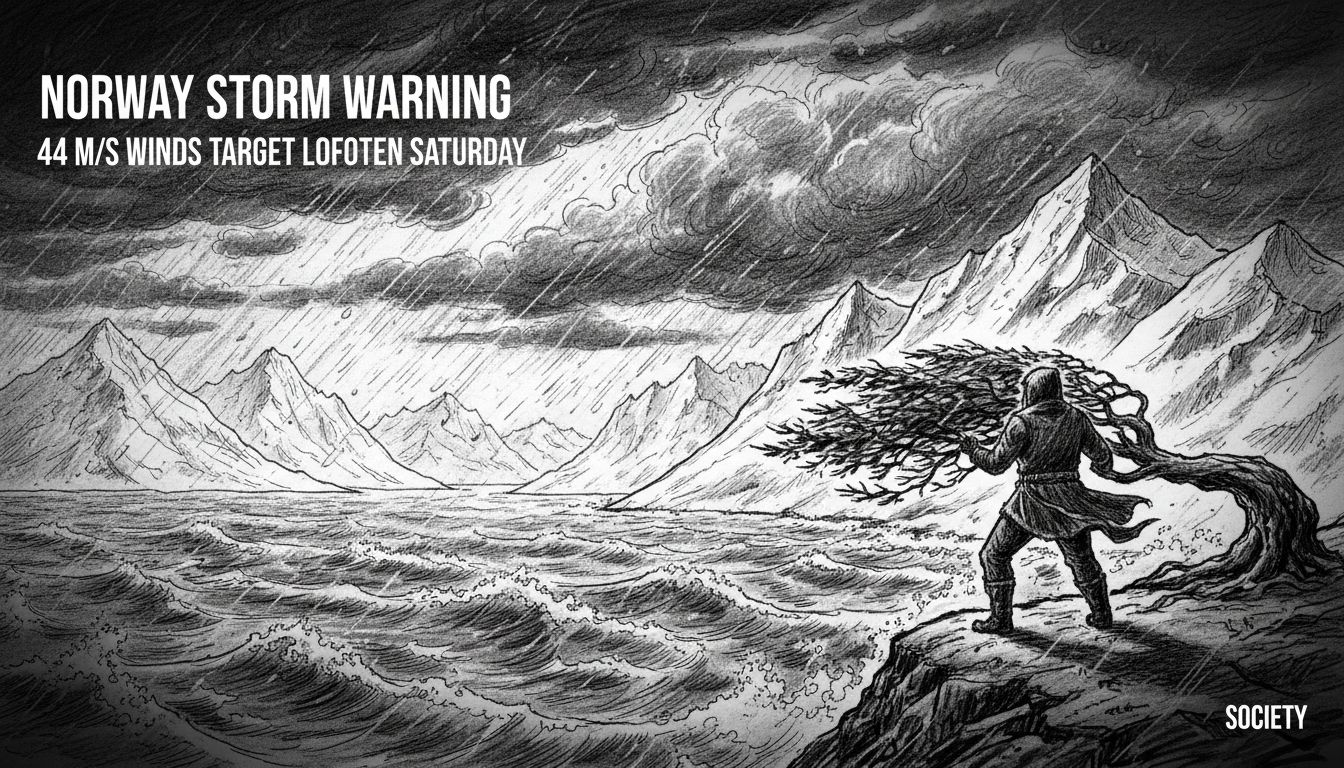
Norway's Meteorological Institute has issued a severe weather warning for large parts of the country, forecasting wind gusts of up to 44 meters per second and significant wave heights of 12 meters. The powerful low-pressure system developing in the Norwegian Sea is set to hit Northern Norway on Saturday, bringing what forecasters describe as a 'wallpapering' of danger alerts across the map. This storm poses a direct threat to coastal communities and critical infrastructure from Trøndelag to Finnmark.
A Rapidly Intensifying System
The core of the storm will first impact the Lofoten archipelago early Saturday morning. Meteorologists expect the area of strongest winds to then spread northeastward and southward throughout the day. Winds are predicted to come from the northwest and north, introducing colder air that will turn precipitation into snow. This combination of hurricane-force gusts and heavy snowfall creates what officials term 'extra challenging conditions' for traffic and public transport. The potential for whiteout conditions and flying debris significantly elevates the risk.
Ferry services along the coast are likely to be suspended, and the Norwegian Coastal Administration has issued advisories for all vessel traffic. Avinor, the state-owned airport operator, is preparing for probable cancellations and delays at regional airports including Bodø, Evenes, and Tromsø. Road authorities have warned that mountain passes and exposed coastal roads, particularly the E6 and E10 highways in the north, may close with little notice.
The Geographic Bullseye: Lofoten, Vesterålen, Salten
The regions of Lofoten, Vesterålen, and Salten are in the direct path of the most extreme weather. These areas, famed for their dramatic peaks rising directly from the sea, are exceptionally vulnerable to coastal storms. Local municipalities have activated their emergency preparedness teams. "We are urging residents, especially in isolated fishing communities, to secure boats, outdoor furniture, and anything that could become a projectile," said a spokesperson for the Nordland County Council.
The expected significant wave height of 8 to 12 meters on exposed coastal areas threatens infrastructure. Breakwaters, piers, and seaside roads could sustain damage from wave action and storm surge. The fishing industry, a cornerstone of the local economy, faces a mandatory standstill, with vessels ordered to seek safe harbor well in advance of the worsening conditions.
National Ripple Effects and Preparedness
While the north bears the brunt, the storm's effects will ripple south. Yellow-level warnings for gusts of 27-35 m/s are in place for the rest of Troms, parts of Finnmark, Trøndelag, and inland areas of Southern Norway. The Norwegian Water Resources and Energy Directorate (NVE) is monitoring the situation for potential landslide risk in areas with saturated ground and steep slopes.
The national emergency response network is on heightened alert. The Norwegian Directorate for Civil Protection (DSB) coordinates with county governors to ensure resources are pre-positioned. "Our primary advice is to follow official updates, avoid unnecessary travel, and prepare for possible power outages," a DSB representative stated. Residents are advised to charge phones, have emergency kits ready, and check on vulnerable neighbors.
Expert Analysis: A Predictable Yet Potent Threat
Meteorologists note that while such intense autumn and winter storms are a feature of Norway's climate, their precise intensity and track require constant monitoring. "The rapid deepening of this low-pressure system over the Norwegian Sea is the key driver," explained a senior forecaster at the Meteorological Institute. "The sharp contrast between the warm Atlantic waters and the colder polar air mass fuels this development, leading to these exceptional wind speeds."
Climate researchers point to a broader context. While no single storm can be attributed directly to climate change, the warming of the Arctic and the North Atlantic is believed to influence jet stream patterns and potentially increase the energy available for such systems. Studies suggest the northward shift of storm tracks could make regions like Northern Norway more frequently exposed to severe maritime weather events.
Economic and Operational Impacts
The economic disruption from a storm of this scale is immediate. Offshore oil and gas installations in the Norwegian Sea have received severe weather warnings, impacting helicopter traffic and potentially slowing production. The shipping and logistics sector faces delays, with port operations likely to halt during the peak of the storm. Insurance companies brace for a surge in claims related to property damage, fallen trees, and vehicle incidents.
For the energy grid, Statnett, the system operator, prepares for potential faults on power lines, especially those crossing exposed mountain areas. Local distribution companies have crews on standby to respond to outages caused by falling trees and branches on lines. The public is reminded to treat all downed power lines as live and dangerous.
A Nation Accustomed, But Never Complacent
Norwegians possess a deep-seated cultural awareness of weather and preparedness, known as 'dugnad'—the spirit of communal effort. This collective resilience is routinely tested by the nation's geography. However, authorities consistently stress that complacency is the greatest danger. The transition from a strong breeze to storm-force winds can be deceptively fast, catching even experienced locals off guard.
As the low-pressure system gathers strength over the Norwegian Sea, the country watches, waits, and prepares. The coming hours will test forecasts, infrastructure, and the effectiveness of public warnings. The true measure of success will be found not in the recorded wind speeds, but in the safety of communities weathering the storm. Will this event be remembered as a severe but managed weather incident, or a catalyst for reviewing the resilience of Norway's northern frontiers?