
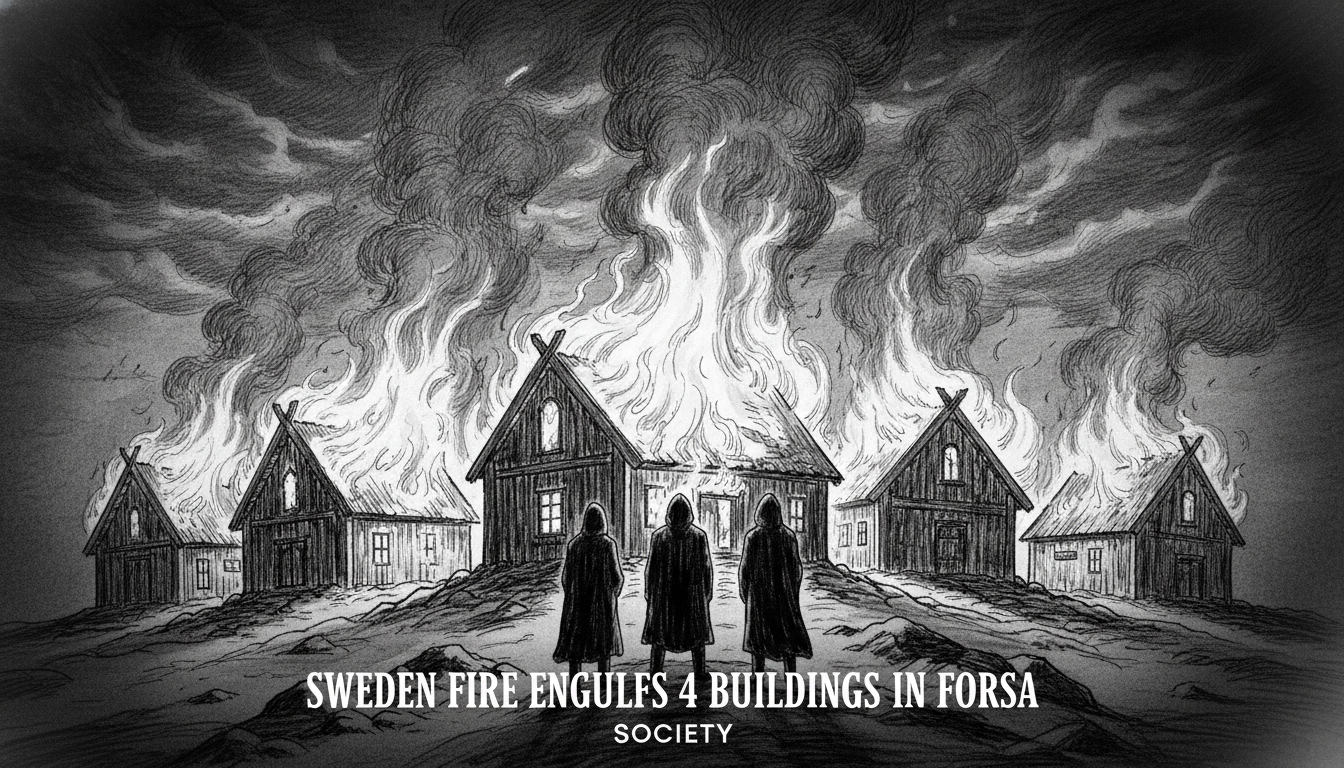
Sweden's emergency services responded to a major fire in Forsa, Hälsingland, after SOS Alarm received the call at 2:42 PM. Four buildings were fully ablaze when firefighters arrived, with two firefighting units and a tanker truck deployed to control the intense blaze. No injuries to people or animals have been reported, a fact officials are calling fortunate given the scale of the fire.
“We have the situation somewhat under control regarding the spread,” said Niklas Hammarlund, a spokesperson for the rescue services. His words, measured and professional, underscore the challenging reality faced by crews in rural areas. The fire’s location in Forsa, a locality within Hudiksvall Municipality, presents specific logistical hurdles. Access to water and the distance from larger stations can turn a structural fire into a race against time.
A Community on Edge
The sight of smoke billowing over the quiet, wooded landscape of Hälsingland is a visceral shock. This province is famed for its UNESCO-listed Hälsingegårdar—grand, decorated farmhouses that are monuments to a wooden building tradition. While the affected buildings are not reported to be these historic farms, the event taps into a deep-seated anxiety. Wooden architecture, so central to Swedish cultural identity and the charm of towns across the north, carries an inherent vulnerability.
“You hear the sirens and your heart just stops,” said Anna Lundström, a lifelong Forsa resident reached by phone. “In a small community, every building is someone’s memory, someone’s livelihood. We’re all just hoping it doesn’t reach the old houses down the road.” Her sentiment reflects the tight-knit nature of these areas, where a fire is not just a property loss but a tear in the community fabric.
The Fight to Contain the Flames
Firefighting in Sweden’s less densely populated regions relies on a network of well-trained local brigades. The response to the Forsa fire, involving multiple units, is standard protocol for a declared “storbrand” or major fire. The immediate priority, beyond saving lives, is containment. Preventing the fire from jumping to nearby forests or other structures is paramount, especially under potentially dry conditions.
The use of a tanker truck is a critical detail. It indicates the possible limitations of local hydrant systems or the need to shuttle water from a nearby source like a lake or pond. Swedish rescue services are adept at this, but it adds a layer of complexity to an already demanding operation. The focus now will be on fully extinguishing the blaze and preventing any dangerous re-ignition.
Wood, Tradition, and Modern Risk
This incident inevitably brings Sweden’s relationship with wooden buildings into focus. From the red-painted cottages of the archipelago to the historic city centers of towns like Härnösand, wood is the defining material. It’s sustainable, beautiful, and deeply traditional. Yet, experts consistently note the fire risk, particularly in older structures built before modern safety codes.
“The Swedish love affair with wood is centuries old, but it requires a modern commitment to safety,” explained fire safety consultant Erik Blomqvist, who has worked on heritage building projects. “Today, we emphasize compartmentalization, early detection systems like smoke alarms, and accessible firebreaks. The key is protecting our heritage without freezing it in time. We can’t stop using wood, but we must use it wisely.”
This balance is a constant discussion in municipal planning across Hälsingland and similar regions. The goal is to preserve the aesthetic and cultural landscape while integrating invisible safety measures.
The Human Impact Beyond the Headlines
While the physical damage is measured in buildings lost, the emotional toll on a community like Forsa is harder to quantify. In small localities, a cluster of buildings could represent a significant portion of the visible community core. It could be workshops, storage, or homes. The coming days will involve investigations into the cause, assessments of damage, and the start of insurance processes.
For the residents, there is the relief that no one was hurt. That is the singular most important outcome. Yet, there is also the unsettling reminder of fragility. Sweden’s emergency services, from SOS Alarm operators to local firefighters, train relentlessly for these scenarios. Their performance, as indicated by the successful containment and lack of injuries, is a testament to that preparation.
Looking Ahead: Recovery and Resilience
The smoke over Forsa will clear, but the story continues. The cause of the fire will be investigated by authorities. Was it an electrical fault, an accident, or something else? The answers will inform future prevention efforts. For the community, the path is toward recovery. There may be fundraising efforts, support for those directly affected, and a collective reaffirmation of community spirit.
This event, while localized, serves as a microcosm of a broader Swedish experience. It intertwines pride in place and tradition with the practical challenges of safety in a landscape built from flammable material. It highlights the silent, vital work of emergency responders who operate far from the spotlight of major cities. And ultimately, it is a story of a crisis met, controlled, and now navigated—a narrative not of destruction alone, but of response and resilience. The true measure of this community will be seen not in the ashes of today, but in the careful rebuilding of tomorrow.