
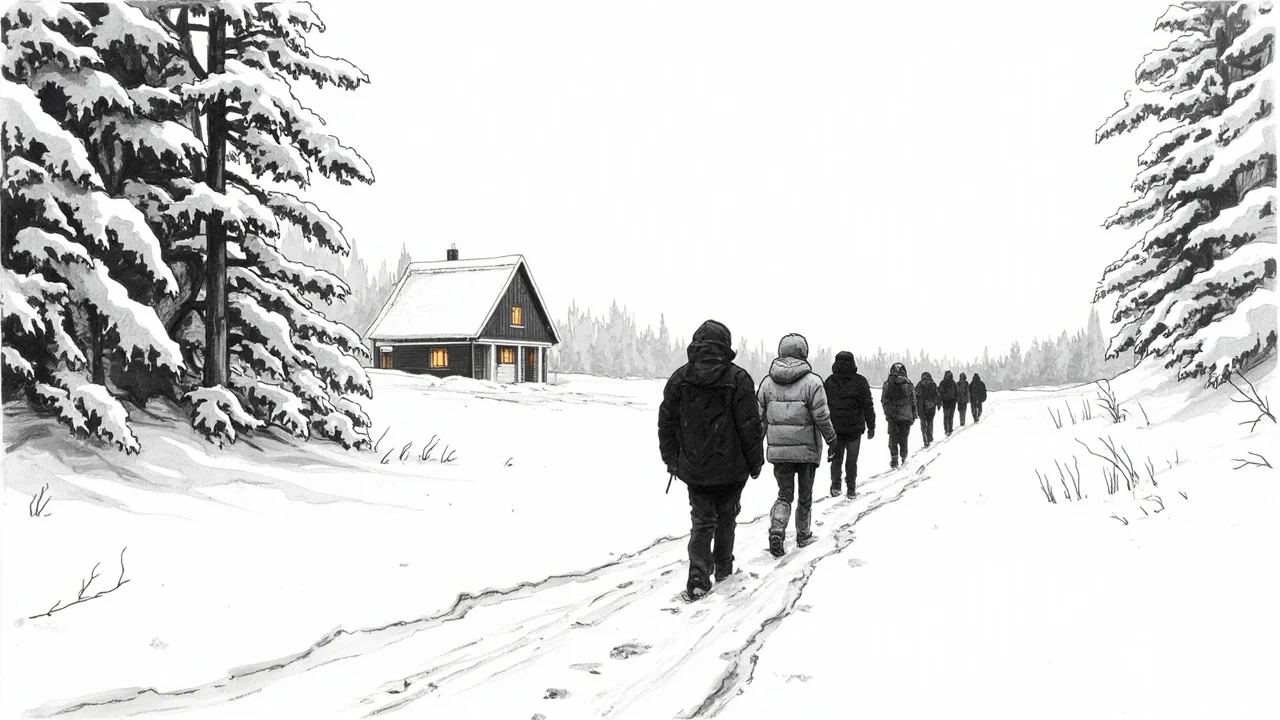
Sweden's extreme cold snap has plunged temperatures to -37°C in the northern Tornedalen region. For 72-year-old Roland Jatko in the village of Routkomaa, it's just another week. He pulls on his layers, grabs his axe, and heads out to chop wood. His survival, and his home's, depends on it. "The important things are clothes, your attitude, and of course the axe," Jatko says, explaining he can use up to one and a half cubic meters of firewood to keep the deep freeze at bay. This is not breaking news here. It is simply life.
While southern Sweden discusses the cold, up here they live it. Jatko's routine becomes a round-the-clock vigil against the ice. "I can be away for a few hours and only sleep for five or six, then I have to get the fire going again," he notes. "Otherwise the pipes would freeze." The concept of a full-time job alongside this winter workload is unthinkable. "Yes, it's too much work," he states plainly. His story is a stark lesson in Swedish resilience, far from the trendy cafes of Stockholm's Södermalm.
The Unseen Rhythm of Arctic Winter
This cold wave, known as a "köldknäpp," is a sharp, intense period of freezing weather. In Tornedalen, a culturally distinct area bordering Finland, it is woven into the annual calendar. The response is not panic, but practiced ritual. It reveals a Sweden often unseen in international media—a land where self-reliance and preparation are not just ideals but necessities. Homes are built with triple-glazed windows and exceptional insulation. Cars are plugged into electrical outlets overnight to prevent engine blocks from cracking. People speak of the cold with a matter-of-factness that can surprise outsiders.
"You get used to it," is the common refrain, or "Man är van" as Jatko puts it. But this familiarity shouldn't be mistaken for ease. It is a hard-earned competence, passed down through generations. It involves knowing how to layer woolen clothing, understanding wind-chill patterns across the open tundra, and maintaining equipment that can mean the difference between comfort and crisis. This cultural knowledge is as much a part of Swedish heritage as Midsummer celebrations or fika.
Beyond the Thermometer: A Cultural Mindset
The real story here isn't the record-low temperature. It's the societal infrastructure and personal mindset that allows communities to function within it. There is a deep-seated trust in the system—that roads will be plowed, that the power grid will hold, that neighbors will check in. This collective resilience is a cornerstone of the Nordic model. It's also a study in contrasts. In the same country where tech startups in Stockholm's "Silicon Valley" are developing apps for seamless living, a man in the north spends hours manually chopping wood for basic survival. Both represent facets of modern Swedish identity.
This self-sufficiency also shapes social bonds. In small villages like Routkomaa, community isn't an abstract concept. It's knowing that if your car won't start, someone will give you a jump. It's sharing a hot drink after clearing a mutual driveway. The cold, in a paradoxical way, fosters warmth. It forces a pace of life that is conscious and deliberate, a stark contrast to the constant buzz of urban centers. This seasonal rhythm is a key part of the local lifestyle, one that newcomers and immigrants to Sweden's north must quickly learn to navigate.
The Quiet Strain on Daily Life
Jatko's mention of disrupted sleep is a critical detail. The cold imposes a physical and mental tax that is constant. Every trip outside requires careful preparation. Simple errands become logistical exercises. For the elderly and those living alone, like Jatko, the winter months demand extra vigilance. Municipalities in Norrbotten County run check-in programs, but the first line of defense is often the individual and their immediate network. This reality highlights the challenges of an aging population in remote areas, a pressing topic in Swedish society.
The economic impact is also personal. Heating costs soar, and the labor to secure fuel is immense. Jatko’s axe is not a rustic prop; it's a vital tool. The consumption of "one and a half cubic meters" of wood he mentions translates to backbreaking labor. This isn't a hobbyist's fireplace; it's a primary heating source. For many, this work is a second, unpaid job that lasts for months. It's a form of shadow labor that rarely appears in economic reports but is essential to making life in the Arctic Circle viable.
A Window into Sweden's Geographic Soul
Sweden often presents an image of sleek design and social liberalism. Stories like this from Tornedalen serve as a crucial reminder of the nation's vast geographic and cultural breadth. The Sami indigenous communities further north have coexisted with this climate for millennia, their reindeer herding traditions adapted to its extremes. Tornedalen itself, with its Meänkieli-speaking population, has a unique cultural identity shaped by borderlands and harsh climates. The cold is a unifying experience, but the responses are infused with local tradition.
This region is also on the front line of climate change. While this week is brutally cold, winters are becoming more unpredictable overall, with volatile swings between mild spells and intense freezes. This volatility can be more damaging than sustained cold, as it leads to ice formation that disrupts transportation and threatens wildlife. The deep, stable cold Jatko is managing is, in a way, a known quantity. The changing patterns pose a new, more complex challenge for Swedish society and its relationship with nature.
The Takeaway: Resilience in Routine
As the cold snap eventually eases and temperatures in Tornedalen climb back toward a mere -15°C, life will feel momentarily easier. Roland Jatko will get a few more hours of sleep. But the preparedness won't vanish. The woodpiles will be replenished, the insulated clothing will remain on the ready, and the mindset of endurance will persist until spring's true thaw.
His story, in its simplicity, captures something profound about a segment of Swedish life. It's a narrative not of dramatic struggle against the elements, but of quiet, unwavering integration with them. The resilience isn't shouted; it's demonstrated in the steady swing of an axe, in the routine stoking of a fire, in the understated words, "Man är van"—you are used to it. For the rest of Sweden, and for the world looking on at the startling temperature maps, it's a powerful lesson in what true adaptation looks like. It asks us what we are truly prepared for, and what we take for granted when the mercury doesn't plunge quite so far.