
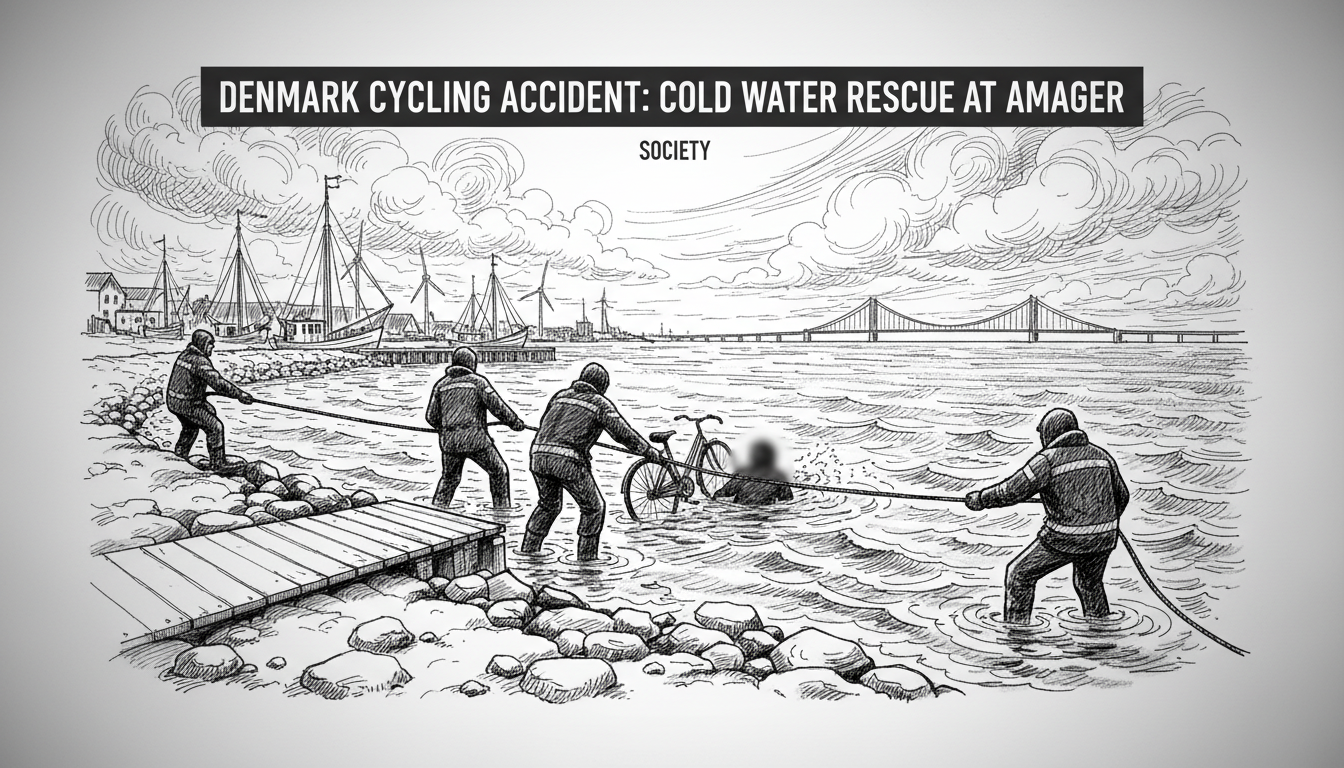
Denmark saw a swift community response Monday evening when a man in his fifties was rescued from the frigid waters of Amager Strandpark. The Copenhagen cycling accident ended positively only because other citizens pulled him to safety after he fell from his bike. The man was reported to be unharmed but understandably cold, according to police.
The incident highlights the ever-present risks in one of the world's most bicycle-centric cities, even within its popular recreational spaces. Water temperatures in Copenhagen's harbor can plummet to near freezing at this time of year, making rapid rescue critical to prevent hypothermia. This event underscores a quiet reality of urban life here, where extensive waterways and a massive cycling population occasionally intersect with dangerous results.
A Monday Evening Plunge
The rescue occurred at the popular Amager Strandpark, an artificial island and beach area that opened in 2005. Details from the scene suggest the man fell from his bicycle directly into the water. Bystanders acted quickly, pulling him from the cold water before emergency services arrived. Copenhagen Police confirmed the incident and the man's condition, emphasizing the fortunate outcome.
Such incidents, while not daily occurrences, are a known hazard in a city built around cycling and water. With over 62% of Copenhageners commuting by bike daily, the sheer volume of cyclists increases the statistical probability of accidents. The city's infrastructure is designed to minimize risk, yet unpredictable events remain. A slippery path, a moment of distraction, or a mechanical fault can lead to a dangerous fall.
The Culture That Saved Him
This rescue was not performed by specialized teams first, but by fellow citizens. This aspect speaks directly to the social fabric of Danish society. There is a strong, often unspoken, civic expectation to help others in need. The social contract within Denmark's welfare system extends beyond state-provided services to include communal responsibility.
‘The quick actions of ordinary people often make the critical difference in these cold water scenarios,’ says Lars Jensen, a senior instructor with the Danish Life Saving Society. ‘Hypothermia can set in rapidly. That community instinct to intervene is as vital as any official safety protocol.’ This informal safety net complements Copenhagen's formal emergency response networks.
Infrastructure and Invisible Risks
Copenhagen is globally renowned for its cycling infrastructure, boasting over 400 kilometers of dedicated cycle tracks. The city is a case study in urban planning, where bicycles outnumber cars by approximately five to one. Investment in safe, separated lanes is a continuous priority for municipal authorities.
However, this specific accident points to a nuanced challenge. How do you perfectly safeguard every meter where cycle paths meet open water? Amager Strandpark is designed for leisure, with paths offering beautiful waterfront views. The very feature that makes it attractive also introduces a element of risk. Railings and barriers exist in many places, but cannot be omnipresent without destroying the open aesthetic of the park.
‘We constantly evaluate safety,’ a city maintenance official told Nordics Today, speaking on background. ‘Each incident is reviewed. The balance is between an open, inviting recreational space and implementing necessary physical safety measures. Public awareness is also a key component.’
The Medical Reality of Cold Water
The term ‘uskadt’ or unharmed in the police report likely means no major physical trauma. Yet medical experts note that a plunge into winter harbor water is a serious shock to the body. Water temperatures now can be around 2-4 degrees Celsius.
Dr. Anette Fischer, an emergency room physician at a Copenhagen hospital, explains the physiological stakes. ‘The initial gasp reflex can cause inhalation of water. Cold shock drastically increases heart rate and blood pressure, risking cardiac events. Even a fit, healthy person can become incapacitated within minutes. The fact he was pulled out quickly is the main reason this wasn’t a tragedy,’ she states.
Her analysis underscores the narrow margin for error. The citizens who pulled the man out likely prevented a rapid decline into hypothermia, where muscle failure makes self-rescue impossible.
Analysis: A System Tested and Validated
This event serves as an informal test of several interconnected systems: civic responsibility, urban design, and emergency preparedness. It passed. The human response layer functioned instantly. The municipal layer, in the form of police and potentially ambulances, was alerted and responded.
From a Danish social policy perspective, it reinforces the model of interdependent safety. The state provides the infrastructure and the professional responders. The citizens provide the immediate, on-the-ground human response. This synergy is fundamental to the societal model’s functionality. It is also a powerful argument for continued public investment in communal spaces like Amager Strandpark, which foster the community bonds that prove essential in crises.
Furthermore, it highlights an area for potential public information campaigns. While Danes are generally aware of winter dangers, specific education on cold water shock and basic rescue techniques could be valuable. The Danish Life Saving Society regularly offers courses, but broader integration into public safety messaging could be considered.
A Look at the Bigger Picture
Statistically, Copenhagen remains incredibly safe for cyclists. The number of serious accidents relative to the millions of kilometers cycled daily is low. The city’s target is to have zero serious cycling injuries by 2030. Incidents like this, while dramatic, are rare outliers in a generally successful urban mobility system.
Yet each one provides a learning opportunity. It reminds authorities to check specific locations for potential enhancements. It reminds cyclists to be extra vigilant on wet, dark paths near water. And most importantly, it reminds everyone of the value of looking out for one another.
The unnamed man at Amager Strandpark will dry off and warm up, thanks to his quick-thinking neighbors. His story is a short news item, but also a potent reminder. In Denmark’s carefully engineered society, the most critical safety feature often isn’t concrete or asphalt. It’s the person next to you, willing to reach out a hand.
Will this incident lead to new barriers along that stretch of path? Probably not. The Danish approach typically favors targeted solutions over broad overhauls when risk is deemed low. But it will likely enter the dataset that planners use to assess safety city-wide. And it will certainly reinforce the profound truth that community vigilance is the ultimate public safety infrastructure.