
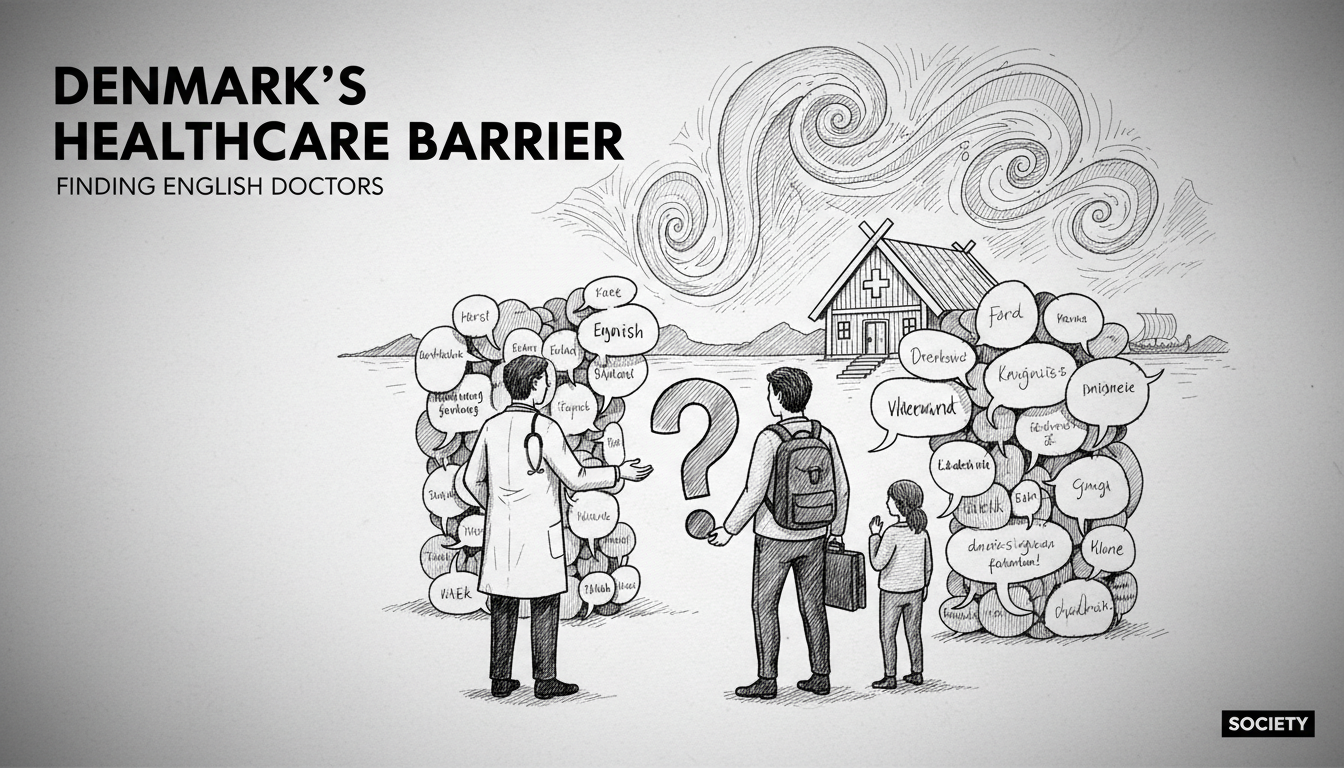
Denmark’s foreign-born population, now 13%, faces a stark healthcare paradox. The nation's universal, tax-funded system ranks among Europe's finest for quality and access. Yet for thousands of international residents, a fundamental barrier remains: language. A British software developer’s recent experience in Copenhagen is a weekly reality. Seeking care for a persistent cough, she arrived at her local clinic only to find no English-speaking staff. This gap between world-class care and accessible communication defines a critical integration challenge within the Danish welfare model.
A System Built on Danish Logic
Denmark’s healthcare structure is decentralized and efficient for those who navigate it in Danish. Every resident receives a yellow health insurance card (sundhedskort) after registering for a CPR number. This card grants access to a chosen general practitioner (GP) within one’s municipality. The GP acts as a gatekeeper for all non-emergency care. For Danish speakers, this system is seamless. For others, the first hurdle appears at the point of registration. The official portals, borger.dk and sundhed.dk, are primarily in Danish. While translation tools help, understanding terms like lægevagt (out-of-hours service) or securing a henvisning (referral) requires guidance.
“The system assumes a level of linguistic and cultural familiarity,” notes Lars Bo Andersen, a social policy researcher at Aarhus University. “It is designed for homogeneity. When 13% of your population comes from outside that linguistic circle, friction is inevitable.” This friction is not merely about inconvenience. It can lead to misdiagnosis, medication errors, and delayed treatment. It also discourages preventive care, as the effort to book a routine check-up feels daunting.
Navigating the Pathways to English Care
International residents must employ specific strategies. The most straightforward path is through private clinics. In Copenhagen, clinics like Copenhagen Medical and International Medical Clinic operate entirely in English. Consultations cost between 1,200 and 1,800 DKK, often with same-day booking. Some costs can be reimbursed through the public system, but the upfront expense is significant. “For acute anxiety or a sick child, the clarity is worth the price,” says Priya Sharma, an Indian project manager living in Østerbro. “But it creates a two-tier system where access is tied to your ability to pay privately.”
Navigating the public system requires more work. On sundhed.dk, one can filter GPs by language under the sprog option. However, “speaks English” can range from conversational fluency to full medical proficiency. Registration requires a CPR number and a visit to the municipal citizen service (Borgerservice). Wait times for a first appointment can stretch to a week. For specialist care, a referral from your GP is mandatory, adding another step where language can stall the process.
University hospitals, like Copenhagen’s Rigshospitalet, often have English-speaking staff, particularly in emergency departments and specialized units. Access, however, almost always requires a GP referral. This makes the choice of an English-competent GP the most critical decision for an international resident’s healthcare journey.
The Municipal Responsibility and Gaps
The responsibility for primary healthcare lies with Denmark’s 98 municipalities. Their approaches to supporting international residents vary widely. Copenhagen Municipality, with its large expat community, offers extensive English information on its website. Aarhus and Odense have fewer dedicated resources. There is no national mandate for providing translated medical services, leaving it to individual clinics and doctors.
“Municipalities are aware of the issue, but resources are allocated based on local political priorities,” explains Karen Mikkelsen, a former integration consultant for a Copenhagen district. “Some health centers offer interpreter services, but booking them adds bureaucratic time to an appointment. The demand for truly bilingual GPs far outstrips supply.” Community social centers, like International House Copenhagen, have become de facto guides, offering workshops on how to use the healthcare system—a service that highlights the systemic gap.
Analysis: A Test for the Welfare Model
This language barrier presents a profound test for Danish social policy. The welfare model is built on principles of equal access and universalism. When a segment of the population cannot access services effectively, that equality is compromised. The growth of a parallel private market for English-language care, while solving an immediate problem, subtly undermines the public system’s inclusivity.
Experts point to a broader integration challenge. “Healthcare is often the first major touchpoint a new resident has with the Danish state,” says sociologist Dr. Helena Sørensen. “A negative, confusing experience here can color their entire perception of society and hinder their long-term integration. It sends a message that the system is not for them.” The solution requires investment. It means actively recruiting multilingual medical staff, standardizing and funding professional interpreter services in clinics, and creating seamless official information channels in English.
Denmark spends 10.6% of its GDP on healthcare. A marginal increase in that spending directed toward linguistic accessibility would yield significant returns in public health outcomes and social cohesion. The alternative is accepting a permanent divide, where the quality of your care depends not just on your health card, but on your Danish vocabulary. For a society keen on integrating its international workforce and talent, fixing this is not just a medical necessity. It is a social imperative.
The Personal Cost and the Way Forward
The human impact is measured in stress and uncertainty. Residents report feeling like a burden during appointments, avoiding care for mental health issues due to language sensitivity, and relying on partners or even their children to translate. This dependency erodes autonomy and dignity. The path forward is clear but requires systematic effort. New arrivals must prioritize their CPR registration and doctor selection. The public system must more visibly advertise its English-speaking GP options.
Ultimately, Denmark’s reputation as a well-functioning society will be judged by how it serves all who live here. A truly universal healthcare system cannot be linguistically exclusive. Bridging this gap is the next frontier for Danish social policy, ensuring the yellow health card offers equal promise to every hand that holds it.