
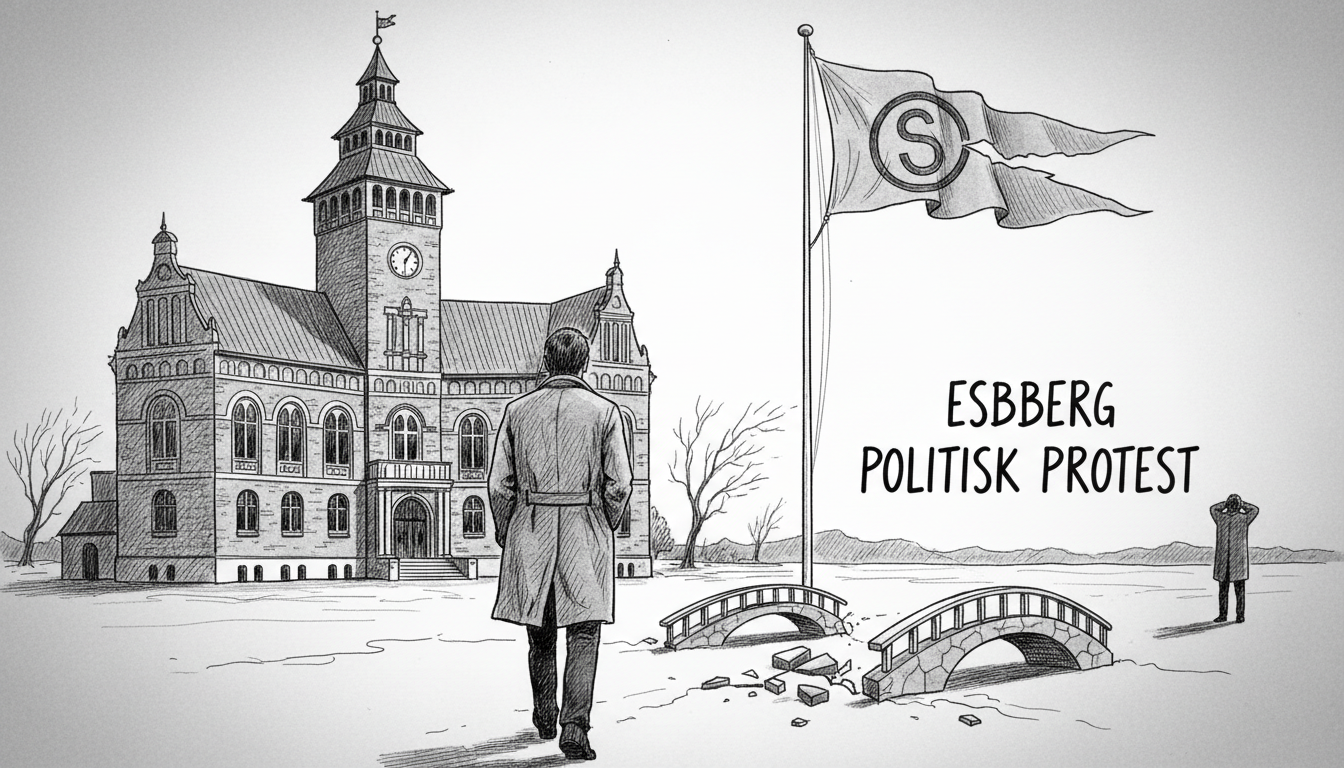
A political power struggle in Esbjerg has forced two council members to abandon Denmark's ruling Social Democratic Party. The party's mayoral candidate Michael Harbøll resigned following internal disagreements about coalition partnerships. He will now serve as an independent on the municipal council where he was elected. This marks the second departure from the Social Democratic council group since the local elections concluded.
Earlier this week, veteran council member Hans Erik Møller also left the party in protest. He subsequently joined the Socialist People's Party instead. The Social Democrats attempted to unseat the incumbent Venstre party and Mayor Jesper Frost Rasmussen during the recent elections. They secured 23.2 percent of municipal votes, representing a 4.2 percentage point decline from previous results. No majority emerged to support a power transition.
On election night, Harbøll used his seven Social Democratic mandates to negotiate a voting alliance with the Red-Green Alliance and Socialist People's Party. This agreement would have secured committee positions across municipal administration. But the majority within the new Social Democratic council group decided to break this arrangement days later. They instead formed an agreement with the Danish People's Party that promised the Social Democrats an additional committee chairmanship.
This political maneuvering prompted Hans Erik Møller's departure after his continuous council service since 1989. The Social Democrats consequently dropped from seven to six mandates, reducing their bargaining power. Their agreement with the Danish People's Party now only secures one committee leadership position. Reports indicated Harbøll was positioned to receive this committee chair role.
The majority within the Social Democratic council group again opposed Harbøll's leadership. They awarded the committee chairman position to Frederik Vestergaard Jørgensen instead. Jørgensen had previously lost to Harbøll in the party's internal mayoral candidate selection during summer months. This repeated rejection prompted Harbøll's final departure from the party structure.
Harbøll stated that a small group had seized control within the local party organization. He accused them of undermining the legitimately elected lead candidate and steering the party in directions contradicting his principles. The personal vote counts reveal substantial public support differences between the rival politicians. Harbøll received 2,373 personal votes while Jørgensen secured only 584 personal endorsements.
This political drama reflects broader tensions within Danish municipal governance. Local power struggles often influence national political dynamics and integration policies. The Copenhagen integration model frequently faces challenges when local factions prioritize internal control over consistent social policy implementation. Denmark's welfare system depends on stable municipal leadership to deliver services effectively.
Political instability at the municipal level can disrupt social service coordination and integration programs. Denmark immigration policy implementation requires consistent local administration to succeed. The Esbjerg situation demonstrates how internal party conflicts can override electoral mandates and personal voter support. Such developments may influence how international observers perceive Danish political stability and governance consistency.